

Start here
Start With a Plan, Not a Shopping Cart
Next
The Foundation Pieces to Prioritize First
Then
Smart Shopping Strategies for Tight Budgets
When you're ready
Building Out Over Time
Start With a Plan, Not a Shopping Cart
The biggest mistake most people make when building a wardrobe from nothing is skipping the planning stage entirely. Without a clear picture of your actual lifestyle — where you go, what you do, what you already own — even a modest budget gets wasted fast on things that don't coordinate or fit your real life.
Start by listing your typical week. How many days do you need casual clothes? Do you work in an office, from home, or somewhere physically active? Do you have regular social events or outdoor activities? Your wardrobe should mirror your real life, not an idealized version of it.
Next, set a realistic clothing budget. If you're working with limited funds overall, our step-by-step monthly budgeting guide can help you carve out a dedicated clothing line without disrupting other priorities. Even $20–30 a month, consistently applied, builds a solid wardrobe over time.
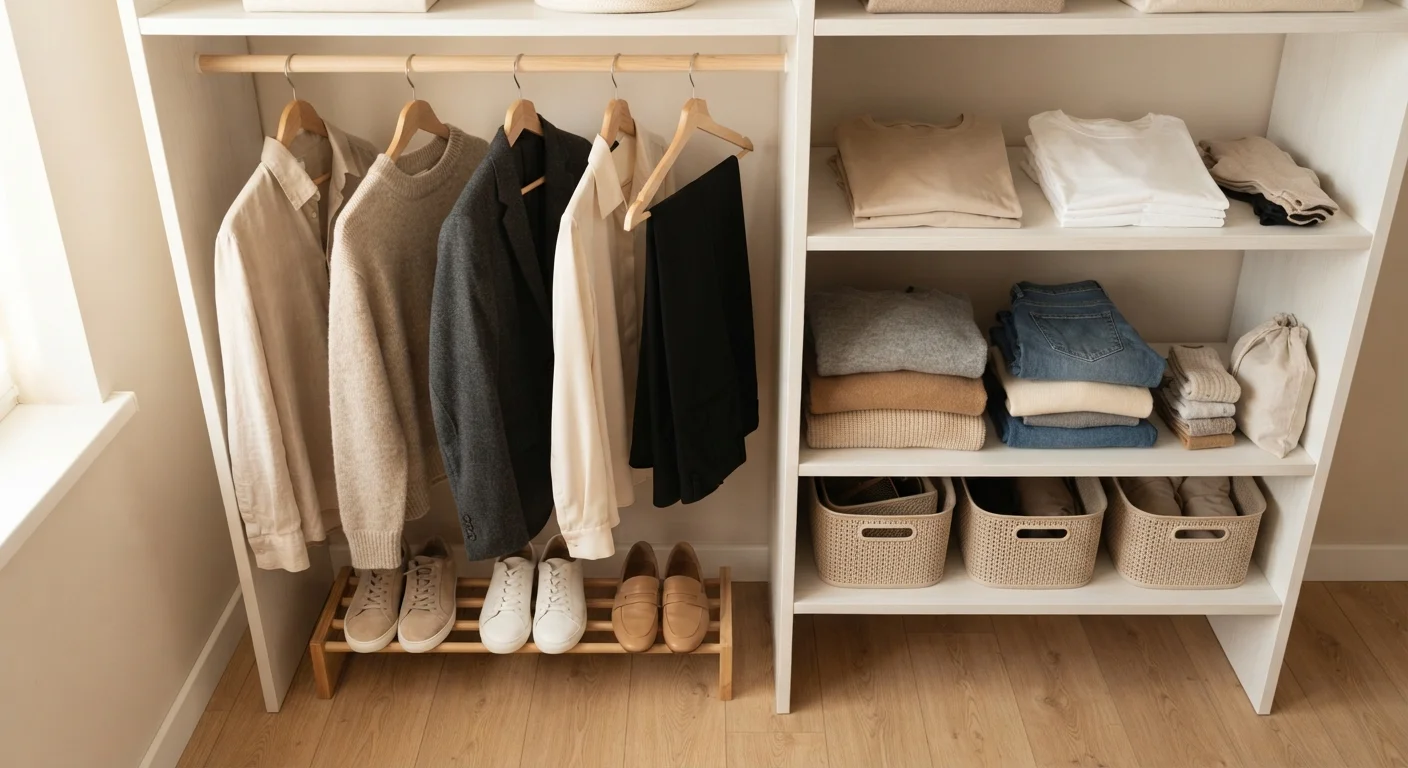
Finally, choose a color strategy before you buy anything. A palette centered on two or three neutrals — think navy, grey, tan, white, black — means almost everything mixes and matches. Building around neutrals is one of the most reliable ways to get more outfits out of fewer pieces.
Write It Down Before You Shop
Keeping a simple notes list of what you need — organized by priority — makes shopping trips far more focused and prevents impulse purchases. Even a short list of five items gives you a decision filter: if something isn't on it, it doesn't go in the cart. Review and update the list as you acquire pieces.
The Foundation Pieces to Prioritize First
Once you have a plan, resist the urge to buy broadly. Instead, go narrow and deep: a small number of genuinely versatile pieces that cover your actual daily needs.
Cost per wear
The purchase price of a garment divided by the number of times you actually wear it. A higher-priced item worn frequently can be better value than a cheap item worn rarely.
Capsule wardrobe
A small, intentional collection of versatile clothing pieces that work well together, reducing decision fatigue and waste.
Neutral palette
A set of low-saturation colors — like white, black, navy, grey, and tan — that coordinate easily with each other and with most accent colors.
Mid-layer
A piece worn between a base top and an outer coat, such as a cardigan, hoodie, or light jacket, that adds warmth and style flexibility.
Off-season shopping
Buying seasonal clothing after peak demand has passed, typically at lower prices — for example, buying a winter coat in spring.
A solid starting foundation for most people includes:
- Two to three pairs of well-fitting bottoms — at least one pair of dark jeans or chinos that can cross casual and semi-dressy contexts
- Four to five tops in neutral tones — plain crewneck or V-neck tees, a chambray shirt, or a simple knit
- One mid-layer — a cardigan, zip hoodie, or unstructured blazer depending on your lifestyle
- One outer layer — a versatile jacket or coat appropriate to your climate
- Two pairs of shoes — one everyday sneaker or casual shoe, one slightly more polished option
That's it to start. This isn't about having a full closet — it's about having a reliable set of pieces that actually work together. For workplace-specific considerations, dressing well for work without a separate work wardrobe shows how a single versatile base can cover professional settings too.
Smart Shopping Strategies for Tight Budgets
With your foundation list in hand, how you shop matters as much as what you buy. A few principles that consistently stretch a limited budget:
- Shop secondhand first. Thrift stores, consignment shops, and community clothing swaps are especially useful for basics and outerwear, where quality often exceeds what's available new at the same price. Understanding the real cost difference between thrift and fast fashion is worth reading before you decide where to spend.
- Think cost per wear. A $50 item worn 100 times outperforms a $10 item worn three times — every time. Durability and versatility matter more than the price tag alone.
- Buy off-season when possible. Coats, boots, and cold-weather layers are dramatically cheaper in late winter and spring. Summer pieces drop in price in August and September.
- Check seams, zippers, and fabric before buying. A low price means nothing if the item falls apart after two washes. Knowing how different fabrics hold up helps you evaluate longevity at the point of purchase.
Avoid the 'It's So Cheap' Trap
Very low prices can create a false sense of savings — especially with fast fashion, where buying five cheap items that don't coordinate or last long costs more than two thoughtful purchases. If an item doesn't fit your plan or color palette, a low price tag isn't a reason to buy it. Budget building requires discipline as much as deal-finding.
Building Out Over Time
Once your foundation is in place and you've worn it for a few weeks, you'll start to notice genuine gaps — a color that's missing, a specific occasion you're not covered for, or a seasonal need. That feedback from real life is far more reliable than any shopping list written in advance.
Add pieces one at a time, with intention. Each new item should work with at least three things you already own. If you can't picture those combinations before buying, the piece is likely to sit unworn. Finding the right balance between statement pieces and basics is a useful next read once your foundation feels solid.
Seasonal transitions are another natural point to reassess. Rather than buying a new wardrobe each season, small targeted additions extend what you have. Navigating seasonal transitions without buying everything new walks through exactly how to do that.
If you want a structured way to evaluate where your wardrobe stands after a few months of building, a wardrobe audit is the logical next step — a practical checklist for identifying what's working, what's missing, and what should go.
Frequently Asked Questions
There's no fixed number, but many people build a functional foundation for everyday life with a few hundred dollars spread over several months. Shopping secondhand, prioritizing versatile basics, and buying in phases makes this more achievable. Setting a monthly clothing line in your budget helps you build gradually without financial strain.
Focus on a few well-fitting bottoms (jeans or chinos), a handful of neutral tops, one layering piece like a cardigan or zip hoodie, comfortable everyday shoes, and one slightly dressier option for occasions. These items cover the widest range of daily situations.
Secondhand shopping is one of the most practical strategies for budget wardrobe building, especially for basics and outerwear. Quality varies, so check seams, zippers, and fabric condition before buying. Thrift stores, consignment shops, and community swap events are all worth exploring.
Think in cost per wear: divide the price by how many times you realistically expect to wear it. A $40 pair of well-made jeans worn 80 times costs $0.50 per wear — better value than a $15 trendy top worn twice. Versatility and durability are the key factors.
Basics first, always. Statement pieces only add value when you have a functional foundation to build around. Without solid basics, bold items become hard to style and often go unworn.
Before buying anything, ask whether it works with at least three items you already own. If you can't picture those combinations, it's likely to become closet clutter. Sticking to a consistent color palette dramatically improves mix-and-match flexibility.
The content on this site is for informational purposes only and is not a substitute for professional advice. Always consult a qualified professional for guidance specific to your situation.