

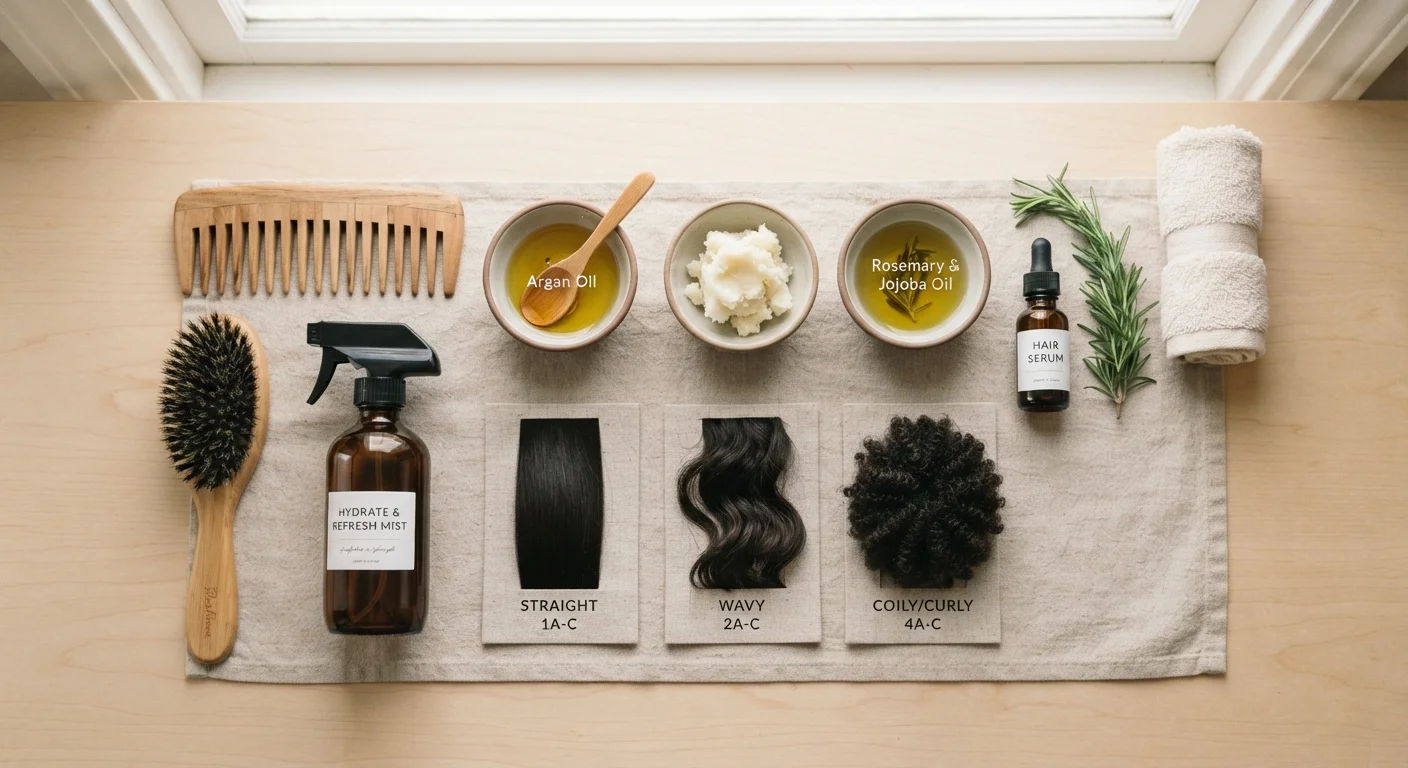
Why Hair Type Is Your Starting Point
Not all hair responds the same way to the same routine — and that's exactly why generic advice so often falls flat. A lightweight daily rinse might be ideal for fine, straight strands but leave a type 4C curl pattern brittle and dry within days. Understanding your hair type isn't about labeling yourself; it's about decoding what your specific strands actually need.
The most commonly used hair typing system runs from type 1 (straight) through type 4 (tightly coiled), with subcategories A, B, and C indicating curl tightness. But texture is only part of the picture. Equally important are porosity (how well your hair absorbs and retains moisture) and strand thickness (fine, medium, or coarse). These three factors together paint a far more accurate portrait of your hair than curl pattern alone.
If you're still pinning down your hair type, our guide on what your hair type actually means walks through every category with practical identification tips. Once you know your type, the rest of your routine starts to make logical sense.
85%
People who report using the wrong shampoo for their scalp type
According to general consumer surveys on hair care habits, the majority of people choose products based on marketing rather than their actual scalp condition.
6–7
Average pH level of a healthy scalp
Dermatology references consistently cite a slightly acidic scalp pH as the norm; disruptions to this range can trigger dryness, oiliness, and irritation.
Scalp First: The Foundation of Healthy Hair
Think of your scalp as the soil from which your hair grows. A scalp that's out of balance — whether too oily, too dry, or dealing with buildup — creates the conditions for slower growth, excess shedding, and dullness before a strand even reaches your shoulders.
A healthy scalp is neither flaky nor excessively greasy, and it shouldn't itch or feel tight. Common disruptors include overwashing, product buildup, hard water, and friction from tight styles worn repeatedly without breaks. Gentle scalp massage during washing improves circulation without causing mechanical damage to fragile roots.
For a deeper look at what balanced scalp care actually involves, see our article on scalp health fundamentals. Getting this part right has a cascading positive effect on everything that follows in your routine.
Scalp Massage Is a Free Habit Worth Building
Spending two to three minutes massaging your scalp during washing increases blood circulation to hair follicles. Use the pads of your fingertips in small circular motions — not your nails, which can scratch and irritate. Over time, this simple habit can support a healthier scalp environment.
Washing Frequency and Technique by Texture
How often you wash is one of the most debated questions in hair care — and the honest answer is that it's personal. Straight and fine hair types tend to show oil and buildup faster, often requiring washing every one to three days. Wavy hair generally does well with two to three washes per week. Curly and coily textures, which have a harder time distributing natural scalp oil down the hair shaft, typically benefit from once-weekly or even bi-weekly washing.
Technique matters as much as timing. Massage shampoo gently into the scalp using the pads of your fingers — not your nails — and let rinse water carry product through the lengths rather than scrubbing the ends directly. For curly and coily textures, finger detangling or using a wide-tooth comb while conditioner is in the hair (not dry) dramatically reduces breakage.
Not sure where to start with your own schedule? Our article on washing too often or not enough helps you read your scalp's signals and adjust accordingly.
Overwashing Is a Surprisingly Common Mistake
Washing daily, especially with a clarifying or lathering shampoo, strips natural sebum faster than the scalp can replenish it — triggering compensatory oil overproduction. If your scalp feels greasy within 24 hours of washing, the cycle of overwashing may actually be the cause. Try extending wash intervals gradually by one day at a time.
Conditioning, Moisture, and Protein Balance
Every hair routine needs both moisture and protein — but the ratio depends on your hair type and its current condition. Moisture (think hydrating conditioners and leave-ins) keeps the hair shaft flexible and reduces breakage. Protein treatments temporarily fill in gaps in the cuticle, adding strength and reducing porosity-related issues like extreme frizz or rapid moisture loss.
Fine, straight hair often only needs a lightweight rinse-out conditioner, while high-porosity or coily hair benefits from regular deep conditioning sessions — typically 15 to 30 minutes under a shower cap — to push moisture into the strand. Signs that your hair needs more moisture: it tangles easily, feels rough, or loses curl definition quickly. Signs it needs protein: it stretches excessively without snapping back, or feels gummy when wet.
Do a simple porosity test at home: drop a clean, shed strand into a glass of water. If it sinks quickly, your hair is high porosity and needs moisture-sealing techniques. If it floats, it's low porosity and needs heat or steam to open the cuticle for conditioning.
Porosity determines how your hair absorbs and retains products. Matching your technique to your porosity level dramatically improves how well conditioners actually work.
Alternate between a moisturizing deep conditioner and a protein treatment rather than doing only one — this maintains the balance that keeps hair both soft and strong.
Overloading on protein can make hair brittle, while too much moisture without protein can cause elasticity loss. Balance is the goal, not maximizing either alone.
For coily and kinky textures, the LOC method (Liquid, Oil, Cream) is a widely used layering approach that helps seal moisture in progressively. Learn more about texture-specific care in our guide to natural hair care practices for coily textures.
Special Considerations: Color-Treated and Chemically Processed Hair
Color, bleach, relaxers, and perms all alter the hair's internal structure — specifically the cortex — making it more porous and more vulnerable to breakage. This doesn't mean you can't have beautiful chemically processed hair; it means your routine needs to compensate for the increased fragility.
Key adjustments for color-treated hair include reducing washing frequency to preserve color pigment, using a gentle sulfate-free shampoo, and prioritizing protein treatments to restore structural integrity. Heat styling should be approached with caution: always use a heat protectant, and consider air-drying when possible to give the hair recovery time.
Double-Processing Significantly Increases Breakage Risk
Applying two chemical services — such as bleaching and then relaxing — within the same period dramatically weakens the hair's structural bonds. Many professional stylists strongly advise against combining these services without adequate recovery time between them. If you are considering any chemical service, consulting a licensed cosmetologist who can assess your hair's current condition is strongly recommended before proceeding.
If your hair has been both chemically processed and heat-styled frequently, consider a temporary break from heat while using a consistent deep conditioning routine. The goal isn't perfection — it's restoring enough strength that your hair can be handled without excessive breakage.
Building Your Routine Step by Step
A complete hair care routine doesn't need to be complicated. The most sustainable version is the one you'll actually do consistently. Start with these core steps and layer in additional practices as needed:
- Cleanse: Choose a shampoo suited to your scalp type — clarifying for buildup, moisturizing for dry scalps, or balancing for combination. Frequency based on your texture and oil production.
- Condition: Apply conditioner from mid-shaft to ends. For curlier textures, use a wide-tooth comb to distribute while conditioning.
- Deep condition: Recommended weekly for high-porosity, coily, or chemically treated hair; every two to three weeks for other types.
- Dry gently: Microfiber towels or a soft T-shirt reduce friction and frizz compared to a regular terry cloth towel.
- Moisturize and protect: Apply a leave-in conditioner, oil, or cream based on your texture's needs before styling.
- Trim regularly: Removing split ends prevents damage from traveling up the shaft. Our guide to trimming hair at home covers what you can safely do yourself between salon visits.
If you're starting completely from scratch, the building a hair care routine from scratch article walks through the whole framework without overwhelming product lists. And for everything hair and grooming, explore the full Hair & Grooming hub for topic-by-topic guidance.
Your Routine Will Evolve Over Time
Hair needs can shift with age, hormonal changes, seasons, and even changes in your local water supply. What works well for you today may need adjustment in a year or two. Treating your routine as a flexible framework — rather than a fixed prescription — makes it far easier to adapt when your hair signals that something has changed.
The content on this site is for informational purposes only and is not a substitute for professional advice. Always consult a qualified professional for guidance specific to your situation.